Section 16 – The Human Case for JanOS
Last modified: 28.1.2026
Beyond economic considerations, JanOS addresses a more fundamental concern: contemporary computing environments impose unnecessary cognitive and emotional load on human work.
Knowledge workers routinely operate within fragmented systems characterized by inconsistent interfaces, opaque behavior, disorganized information, and constant interruption. Over time, this environment erodes clarity, increases fatigue, and makes sustained, thoughtful work harder to maintain.
JanOS approaches this problem not by optimizing individuals, but by reducing the background complexity imposed by the system itself.
Cognitive Load and Comprehensibility
JanOS is designed to reduce cognitive load by making system behavior predictable and understandable.
This is achieved through:
- consistent interaction patterns across applications
- explicit modeling of intent and task boundaries
- semantic organization of information
- gradual disclosure of complexity based on context and role
- system-level assistance that explains rather than interrupts.
The goal is not to accelerate work, but to create a digital environment in which attention can remain focused without constant reorientation.
Dignity, Pace and Satisfaction
The Human Code Principles emphasize that computing systems should respect human limits and rhythms.
JanOS supports this by:
- favoring calm, legible interfaces over dense or attention-seeking designs
- allowing work to proceed at a sustainable pace rather than enforcing constant urgency
- preserving narrative continuity across sessions and time
- supporting autonomy through explicit intent and closure.
Satisfaction in JanOS is not derived from stimulation or gamification, but from the experience of work that progresses clearly and concludes meaningfully.
Time, Memory and Personal Continuity
JanOS treats time as a first-class dimension of work.
Rather than presenting digital activity as a stream of isolated moments, the system allows users to perceive how their work has evolved over time. Through narrative storage, versioning, and optional visualizations, users can revisit earlier stages of their digital environment and understand change as a process rather than a series of disruptions.
Metaphorical representations (such as landscape or world-building views) are optional tools intended to support memory and reflection, not to aestheticize activity. They exist to help users recall when things happened and how work took shape, in ways that align with human recollection rather than exact timestamps.
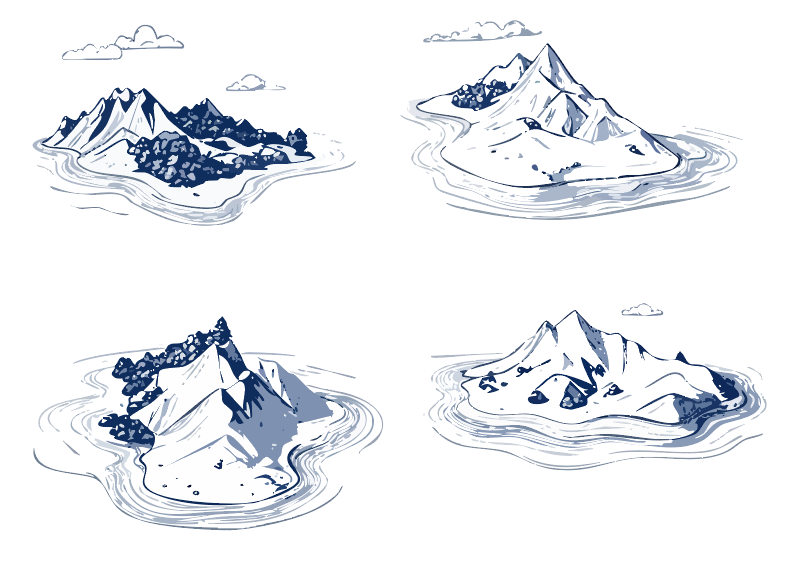
Figure 1. Wireframe design of possible JanOS world-building visualizations, showing various stages of islands, including weather to link with status or emotion.
Making Room for Better Work
By centralizing and automating low-value digital overhead (such as configuration, layout consistency, scheduling, deployment, and logging) JanOS reduces the mechanical labor imposed on human work.
This allows individuals and organizations to focus more fully on:
- analysis and reasoning
- problem solving
- communication and collaboration
- design and learning.
JanOS is not about doing more work, nor about extracting greater output from people. It is about creating conditions in which meaningful work can occur with less friction, greater clarity, and greater respect for human attention.